
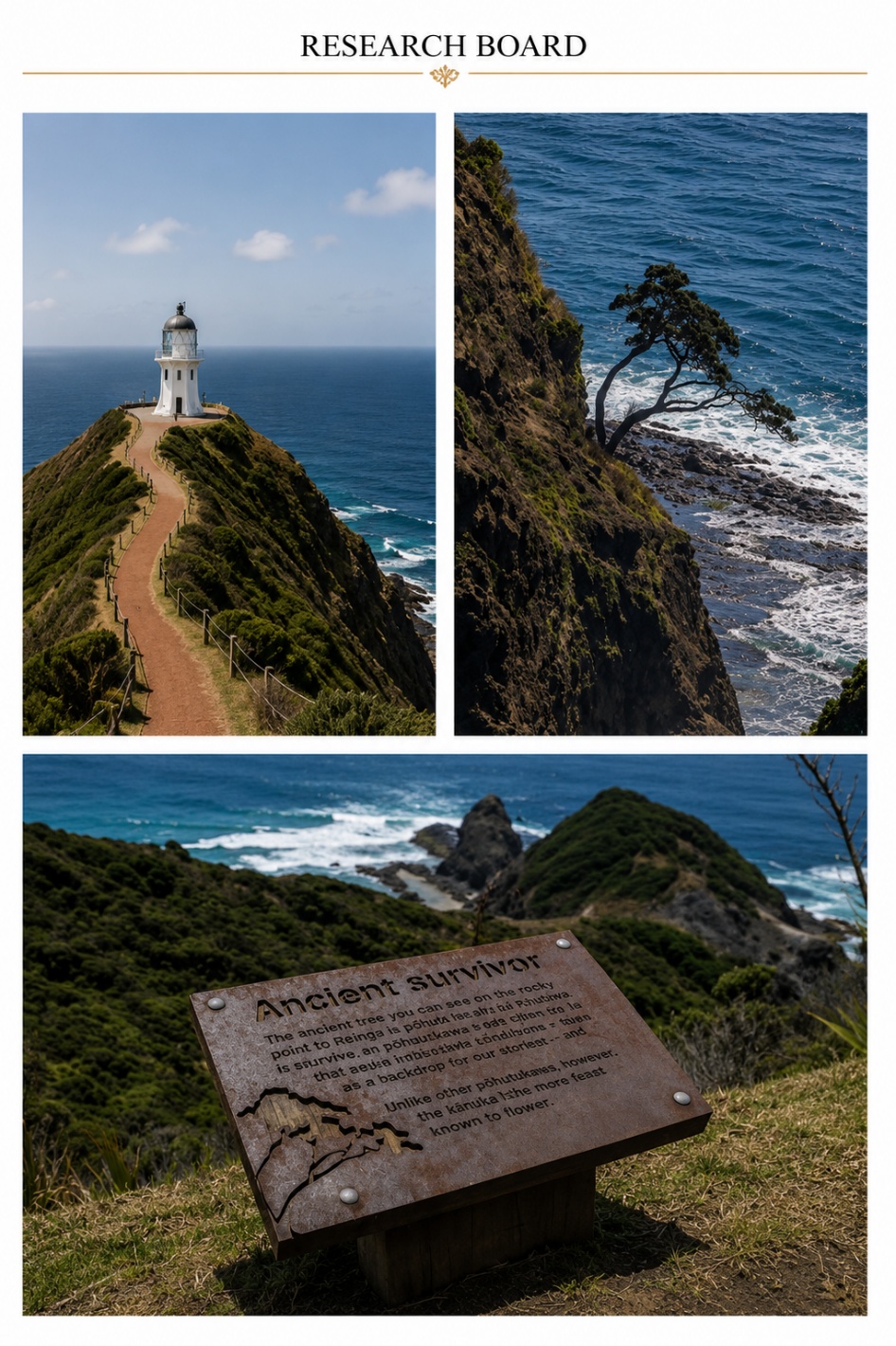
During the research process for REINGA, I encountered the story of Te Rerenga Wairua, Cape Reinga, one of the most significant spiritual locations in Aotearoa New Zealand.
According to Māori tradition, this is the place where the wairua begins its final journey home. At the edge of the northern coastline stands an ancient Pōhutukawa tree whose roots are believed to guide the spirit toward Hawaiki, the ancestral homeland.
What fascinated me was not only the spiritual significance of the place, but the relationship between landscape and cultural memory. Here, geography becomes inseparable from identity, ancestry, and belief. The cliffs, the ocean, the wind, and the ancient tree all form part of a living cultural narrative that has been carried across generations.
As a migrant artist, my connection to this discovery is deeply personal. Navigating different cultures has not always been easy, and experiences of racial discrimination have shaped the way I see the world. These moments have led me to question identity more deeply and to search for the underlying connections that unite us as human beings. Rather than focusing on difference, I have become increasingly curious about how we are fundamentally the same.
This curiosity is what drives my practice. I am drawn to exploring identity as a shared human experience, the one that transcends borders, cultures, and backgrounds. Through wearable sculptures, I aim to communicate stories that provoke dialogue, encouraging communities to reflect, connect, and move beyond division.
Te Rerenga Wairua resonated with me because it embodies a powerful sense of belonging and continuity. It reminded me that identity is not fixed or isolated, but part of a larger, interconnected narrative shaped by memory, place, and collective experience.
This discovery became the foundation for REINGA and continues to influence my broader exploration of culture as a living archive, one that invites conversation, understanding, and connection across communities.
