
Research
CULTURAL & HISTORICAL CONTEXT
Research into Eos within ancient Greek mythology, her relationship to Helios and Selene, and dawn as the transition between night and day. We can use one or two genuine museum/archive objects here rather than decorative mythology imagery.
The development of EOS , Goddess of Dawn began with research into Eos within ancient Greek mythology and the cultural understanding of dawn as a moment of transition. In Greek tradition, Eos personifies the dawn, appearing at the threshold between night and day and announcing the arrival of light.
Ancient literary and visual sources frequently position Eos within the celestial cycle alongside her siblings Helios, associated with the Sun, and Selene, associated with the Moon. Through this relationship, dawn becomes more than a natural phenomenon: it marks a recurring passage between darkness and illumination, ending and beginning, stillness and movement.
Research into ancient Greek representations of Eos revealed a recurring visual language of wings, movement, flowing drapery and forward motion. Rather than reproducing these historical representations, the project considered how their underlying qualities could be translated through contemporary material and sculptural experimentation.
Within EOS, this research gradually developed into an exploration of emergence, renewal, movement and transformation using the mythology of dawn as a historical starting point for a contemporary body of wearable sculpture.
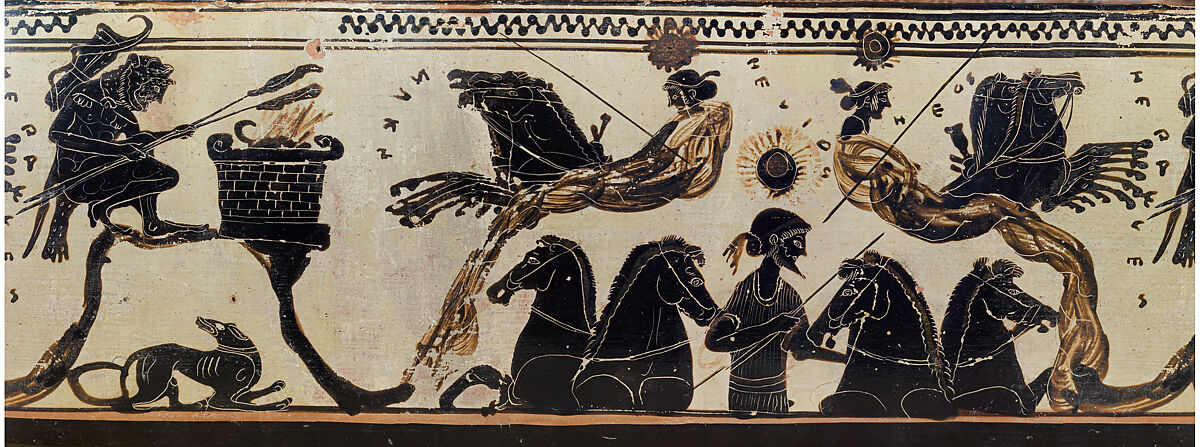
Helios rising, with Nyx and Eos, c. 500 BCE. Attic terracotta lekythos, attributed to the Sappho Painter.
Collection: The Metropolitan Museum of Art, New York. Public Domain.
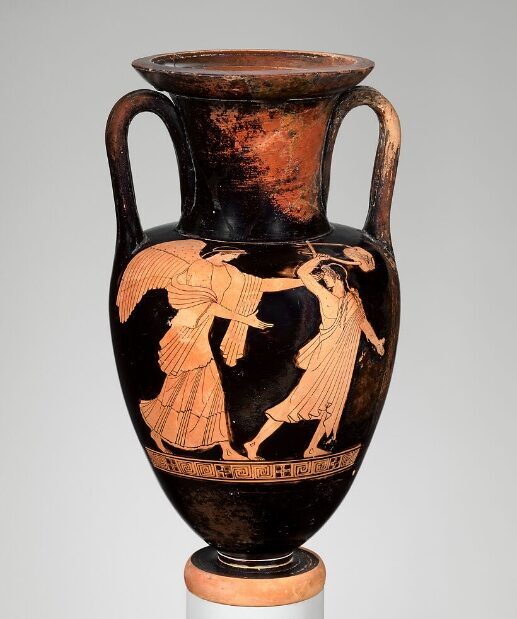
Eos pursuing Tithonos, c. 470–460 BCE.
Attic red-figure Nolan neck-amphora, attributed to the Achilles Painter.
Collection: The Metropolitan Museum of Art, New York. Public Domain.
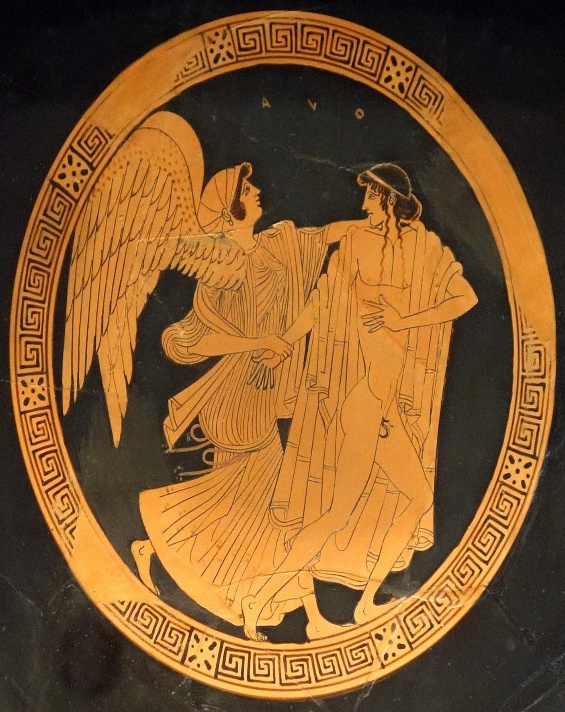
Eos, Helios and Nyx — The Transition from Night to Dawn
Attic lekythos attributed to the Sappho Painter, c. 500 BCE. The scene depicts Helios rising as Nyx (Night) departs and Eos (Dawn) announces the beginning of a new day.
The Metropolitan Museum of Art, New York. Rogers Fund, 1941. Public Domain.
SYMBOLIC RESEARCH
The symbolic research for EOS focused on the recurring qualities associated with dawn: emergence, illumination, movement, transition and renewal. Rather than translating the figure of Eos literally, these ideas became a visual vocabulary through which the work could evolve.
The gradual expansion of light across the sky informed studies of radiating and opening forms, while the winged representations of Eos encouraged explorations of flight, freedom and outward movement. Changing atmospheric colour became equally significant, providing a natural progression from soft, muted tones toward warmer expressions of light.
Together, these references shifted the research from mythology toward an investigation of dawn as an experience, a continual movement from darkness into possibility.
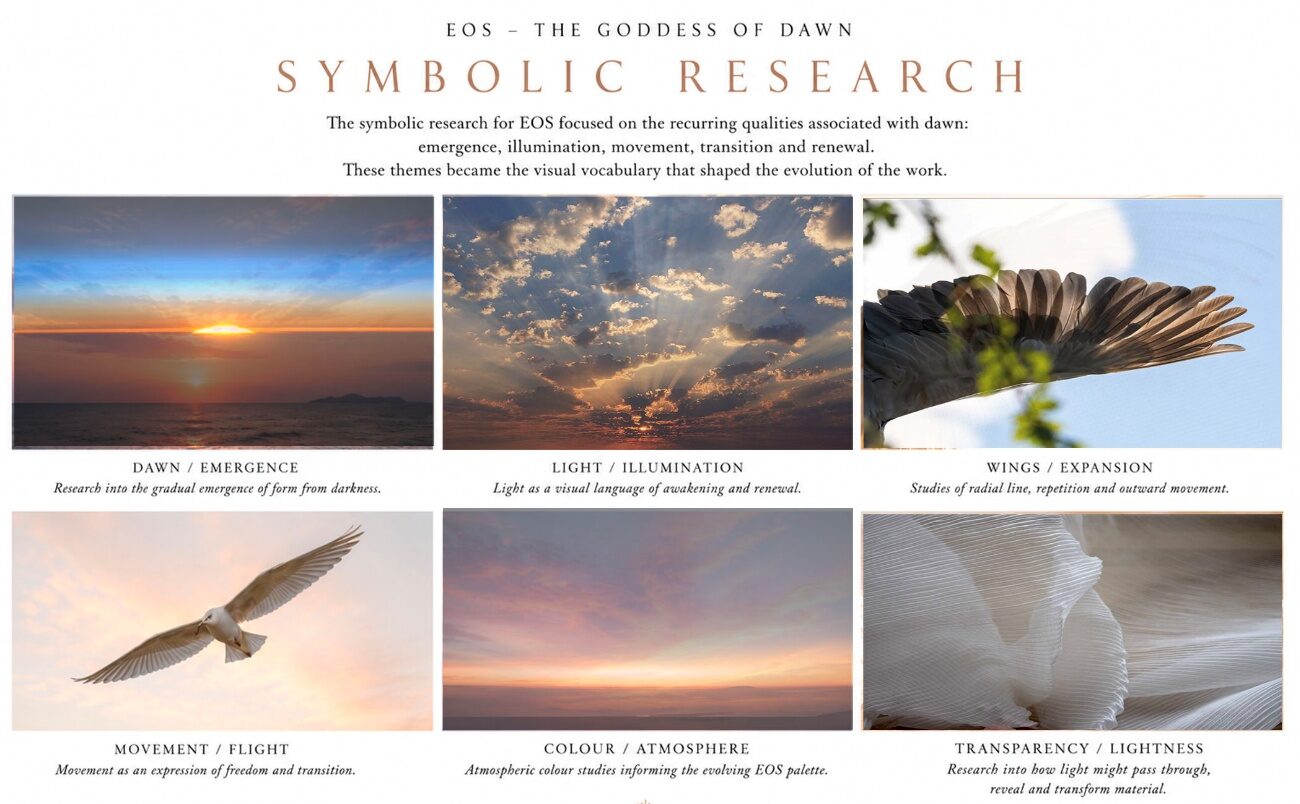
Visual studies exploring the atmospheric and symbolic qualities of dawn through light, colour, movement, flight and expanding natural forms. These references informed the transition from the mythology of Eos toward an original sculptural language based on emergence, renewal and transformation.
CONCEPTUAL RESEARCH
As the research developed, EOS moved beyond the representation of Eos as a mythological figure and toward the broader idea of dawn as a state of transformation. The transition from darkness into light became a metaphor for renewal, awakening, possibility, and the beginning of something new.
The recurring qualities identified through the research like emergence, expansion, movement, lightness and transition gradually became principles for developing the work. Rather than illustrating wings, sunrise, or the goddess literally, these ideas were explored through forms that appear to unfold, radiate, rise, and extend outward from the body.
This shift became central to the development of EOS. Mythology provided the original narrative, while observation of dawn provided its atmosphere; together they evolved into an artistic language concerned with movement, material, space and transformation.
Through this process, EOS became an exploration of a simple but enduring idea: every dawn represents the possibility of beginning again.
Renewal · Awakening · Emergence · Transformation · Movement · Light · Freedom · New Beginnings
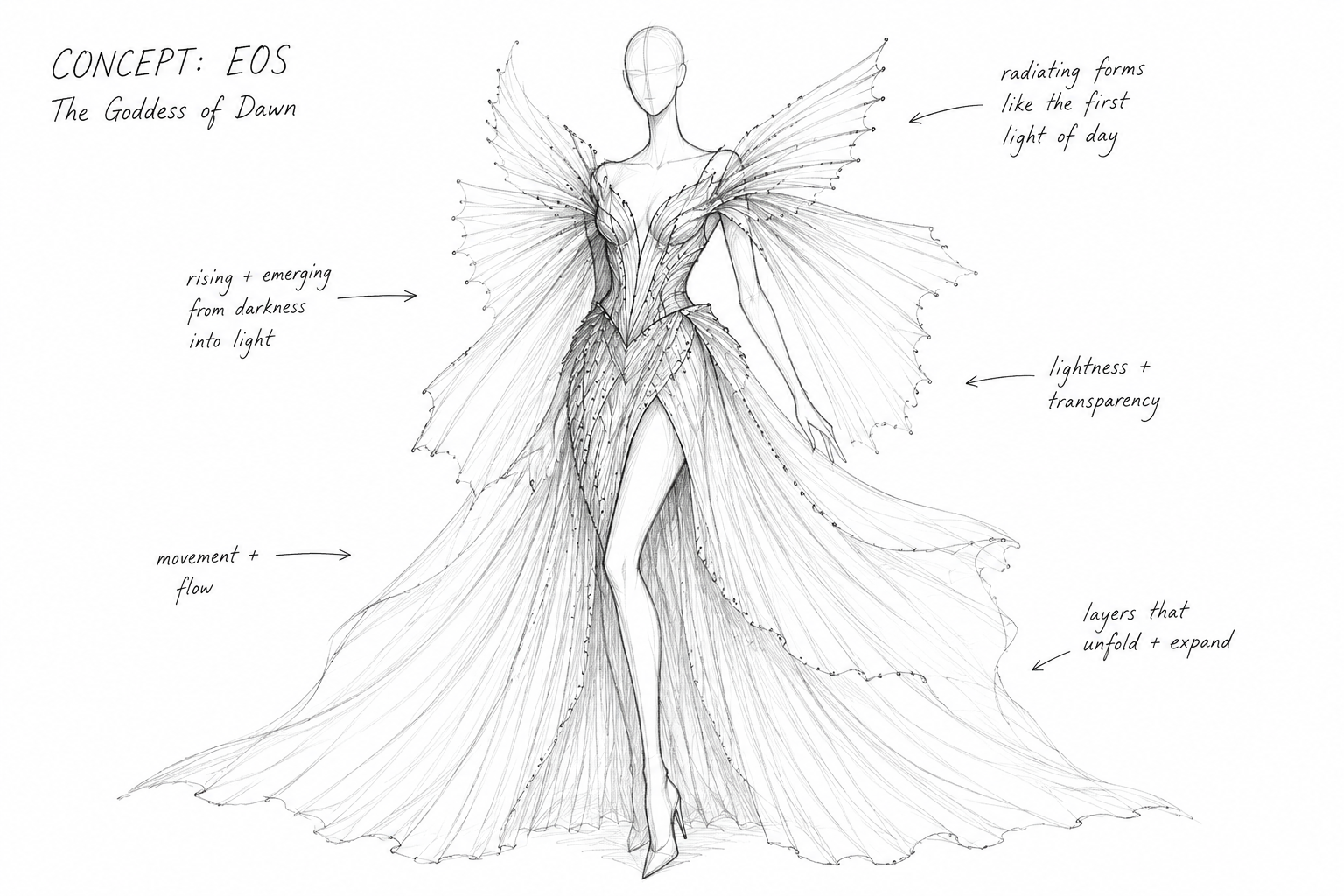
DESIGN DEVELOPMENT
The design development of EOS — Goddess of Dawn translated the ideas of emergence, renewal and movement into a developing language of wearable sculpture. Initial drawings explored how the sensation of dawn could be expressed through line, proportion and material rather than through a literal representation of the goddess.
Sketching became a process of testing forms that appeared to open, rise, radiate and expand from the body. Repeated linear structures, elongated proportions and flowing extensions were developed to create a sense of continuous movement, while the relationship between structured and fluid elements allowed each form to change as the body moved.
As the designs evolved, particular attention was given to creating volume without visual heaviness. The resulting silhouettes began to suggest wings, rays of light and unfolding organic structures while remaining abstract interpretations rather than direct representations.
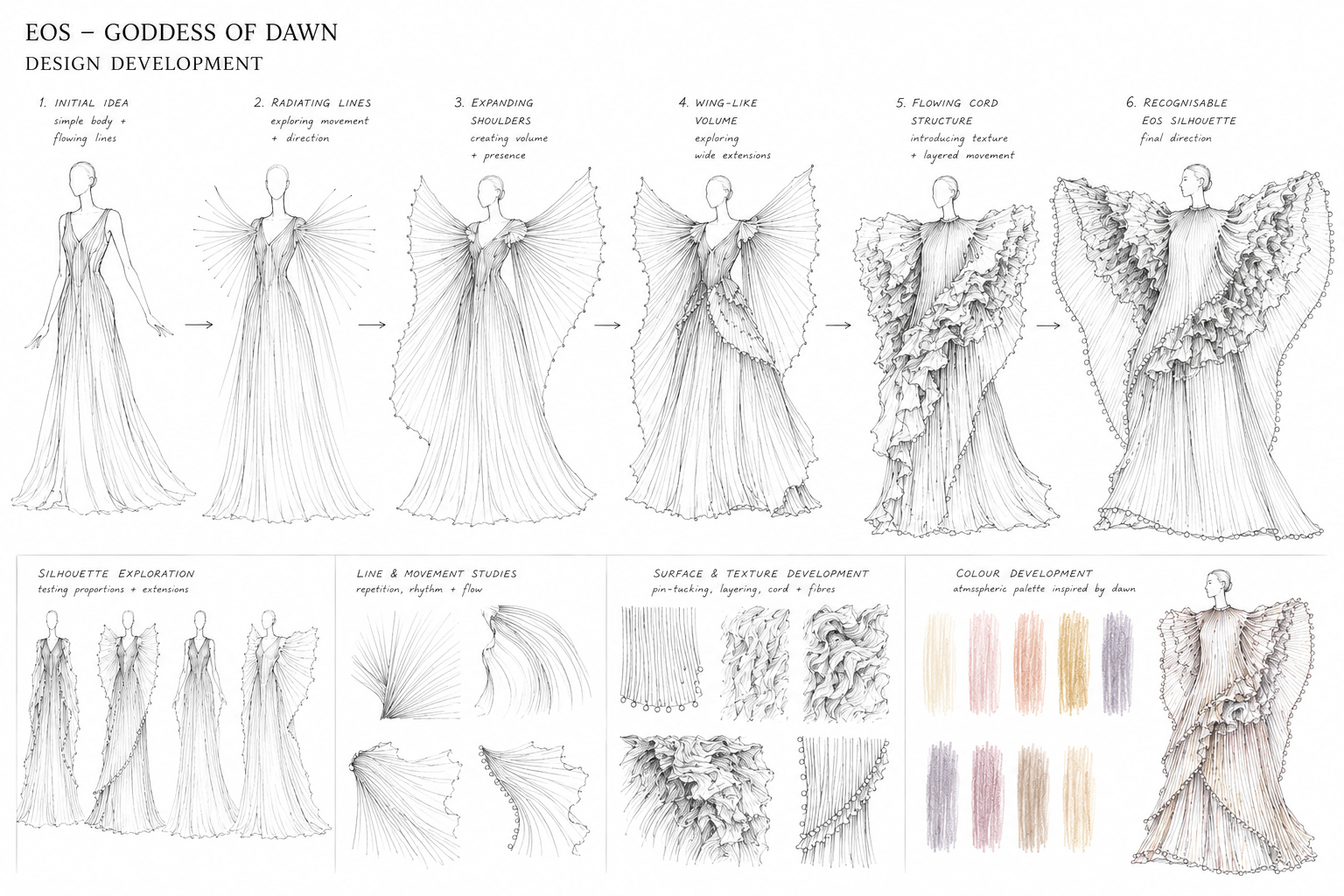
SILHOUETTE DEVELOPMENT
Early silhouette studies explored the relationship between the body and expanding sculptural form. Narrow central structures were contrasted with increasingly wide, radiating extensions, allowing the figure to remain visible while the artwork occupied a much larger surrounding space.
Some forms extended horizontally from the body, while others fell vertically or opened outward through movement. These variations allowed the silhouettes to communicate different qualities of dawn — from the quiet emergence of first light to its gradual expansion across the horizon.
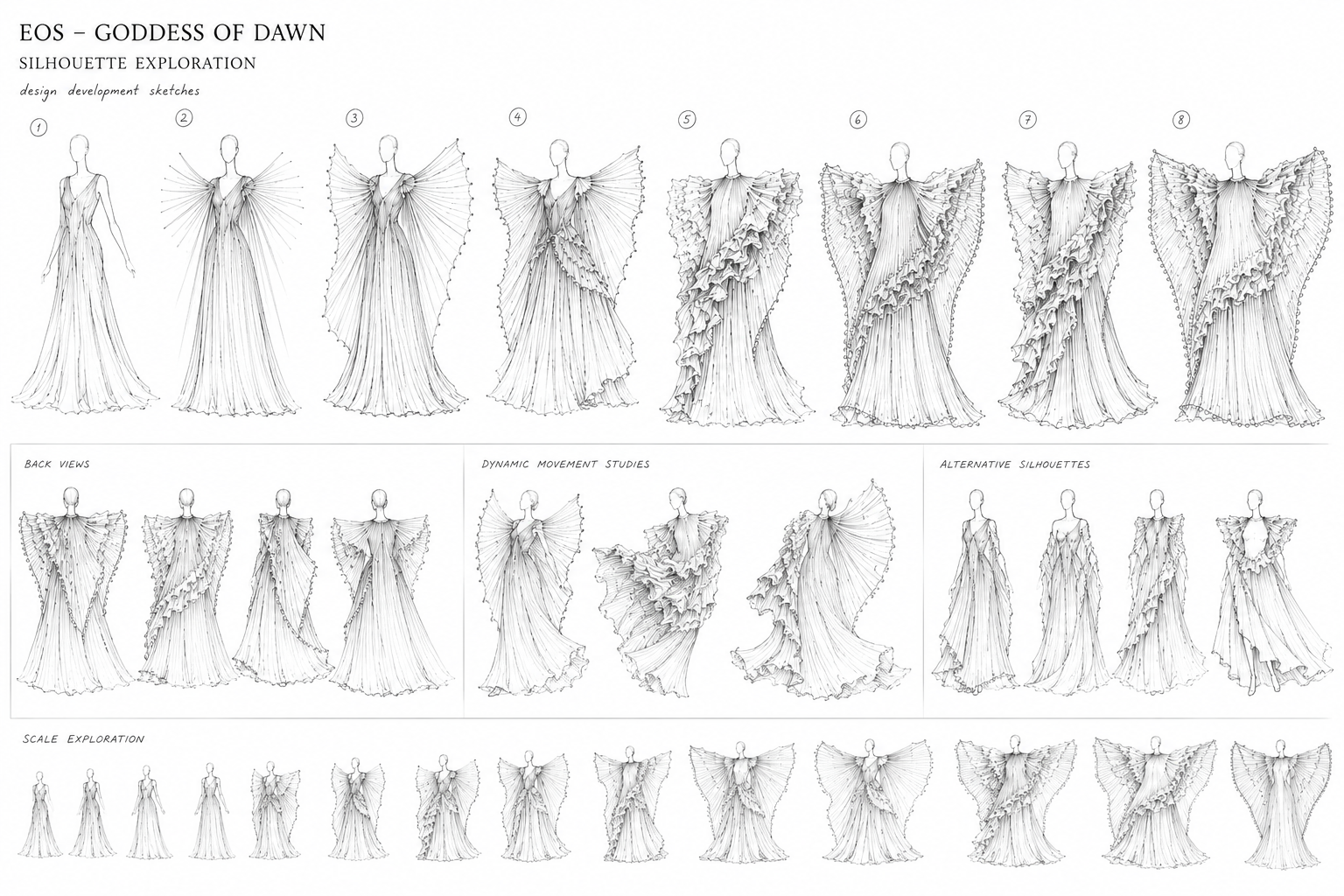
LINE & MOVEMENT STUDIES
Line became one of the defining elements of EOS. Repetition was used to create directional movement across the body, with individual lines gathering, separating and extending beyond the silhouette.
The behaviour of these lines was studied both in stillness and movement. Rather than treating the surface as static decoration, the intention was to allow the construction itself to respond to the wearer, creating forms that could flow, separate, lift and return as the body moved.
SURFACE & TEXTURE DEVELOPMENT
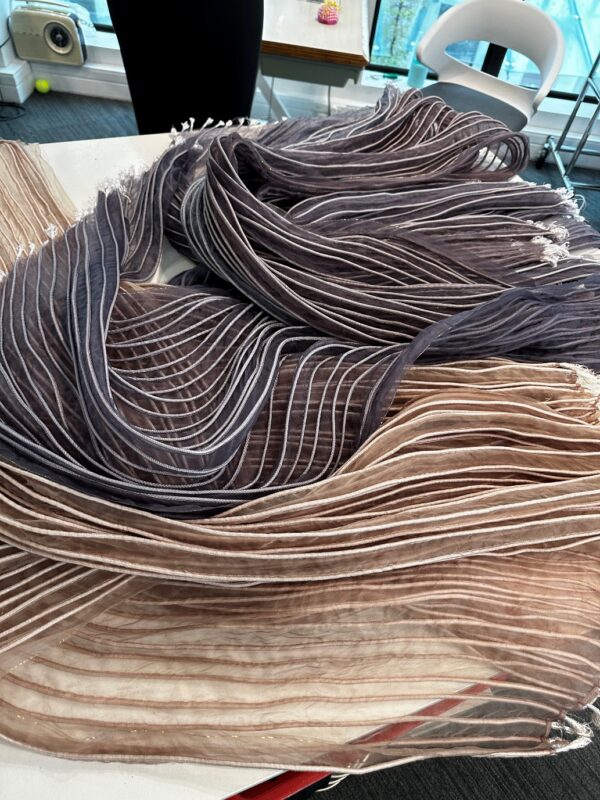
Surface experimentation explored how repeated hand processes could transform relatively simple materials into complex sculptural textures. Pin-tucking, corded structures, layered fibres and densely repeated linear elements were developed to create surfaces that changed according to light, distance and movement.
These experiments established an important relationship between detail and scale: individual lines and fibres remained visible at close range, while collectively they formed larger flowing and feather-like structures around the body.
COLOUR DEVELOPMENT
The EOS palette developed from observations of the changing atmosphere surrounding dawn rather than from a single fixed colour reference. Soft ivory, blush, muted rose, warm earth tones and subtle transitions between lighter and deeper shades were explored to evoke the gradual transformation of the sky as darkness gives way to light.
MATERIAL EXPLORATION & CONSTRUCTION
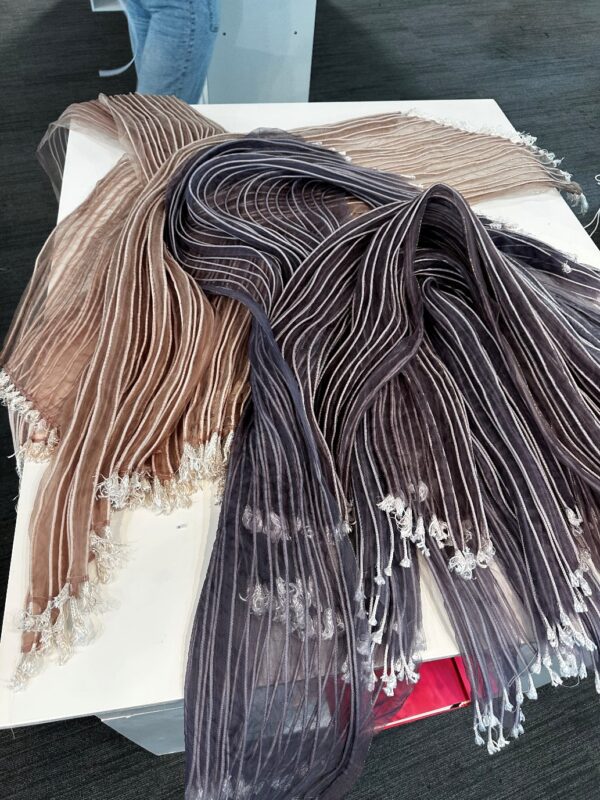
The material development of EOS, Goddess of Dawn centred on transforming linear materials into sculptural surfaces capable of expressing light, expansion and movement. The construction process involved extensive experimentation with cord, textile manipulation, hand dyeing, pin-tucking, nylon fishing line and layered fabric formations.
Rather than beginning with conventional garment construction, many of the forms were developed through repeated material sampling. The behaviour of each material — its weight, tension, flexibility and response to movement, gradually determined the architecture of the silhouettes.
Cord as Structure
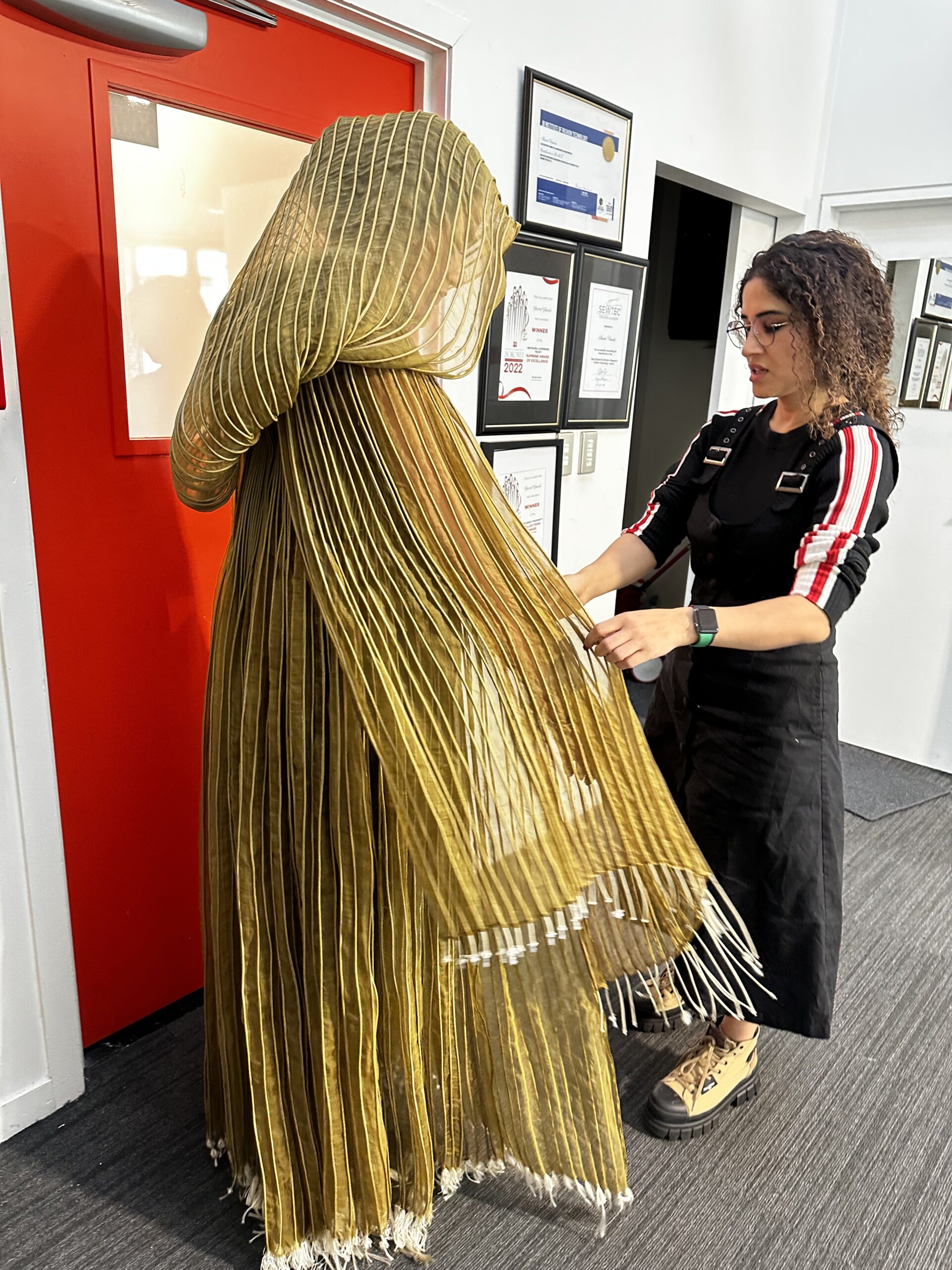
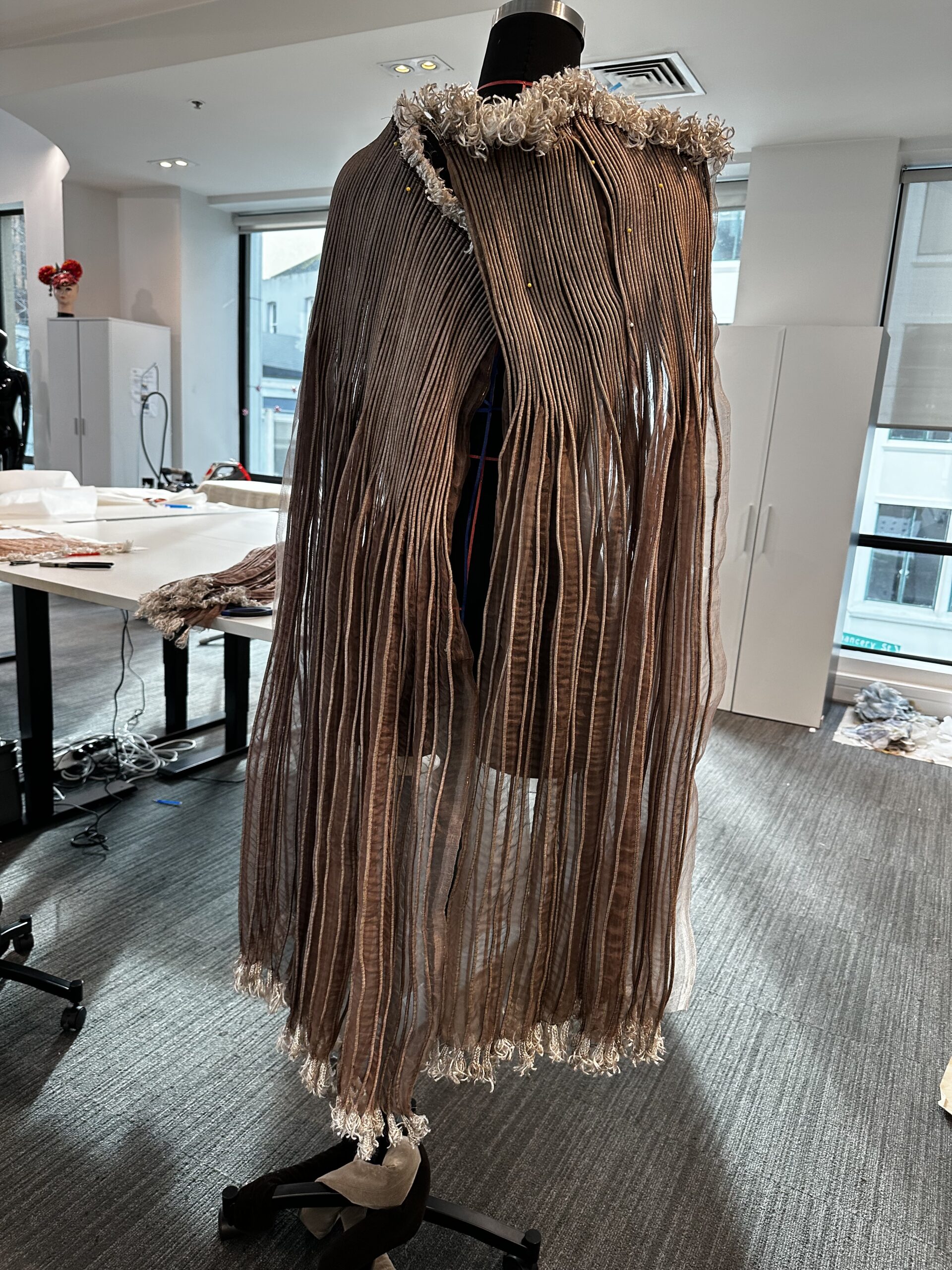
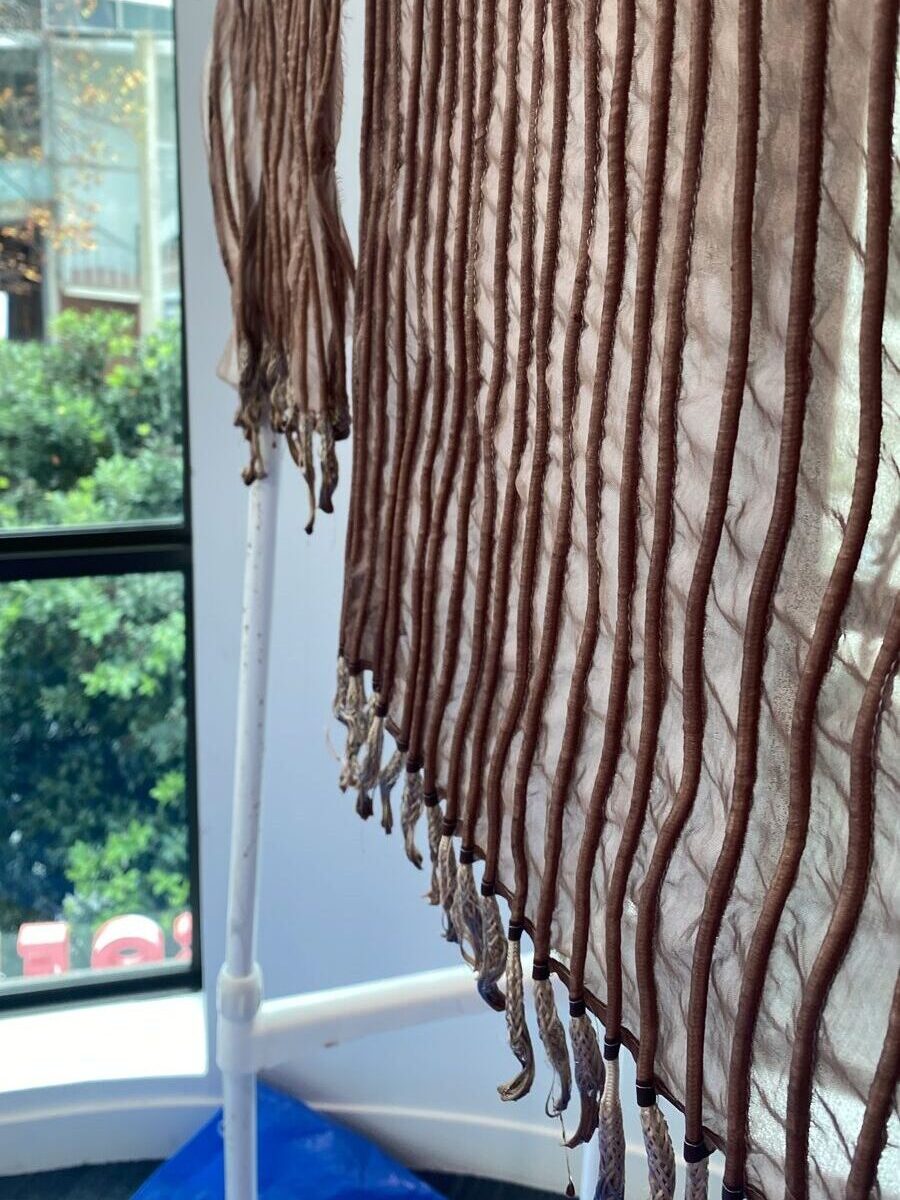
Cord became one of the defining materials within EOS. Thousands of individual lengths were positioned and secured by hand to create continuous radiating lines across the body.
Through repetition, these simple linear elements developed into larger architectural surfaces. The spacing and direction of the cords were repeatedly tested to understand how they could expand away from the body while retaining rhythm and visual continuity.
In several pieces, the cord transitions from closely controlled lines around the torso into dramatically extended structures, allowing the silhouette to open outward almost like wings.
Textile Manipulation
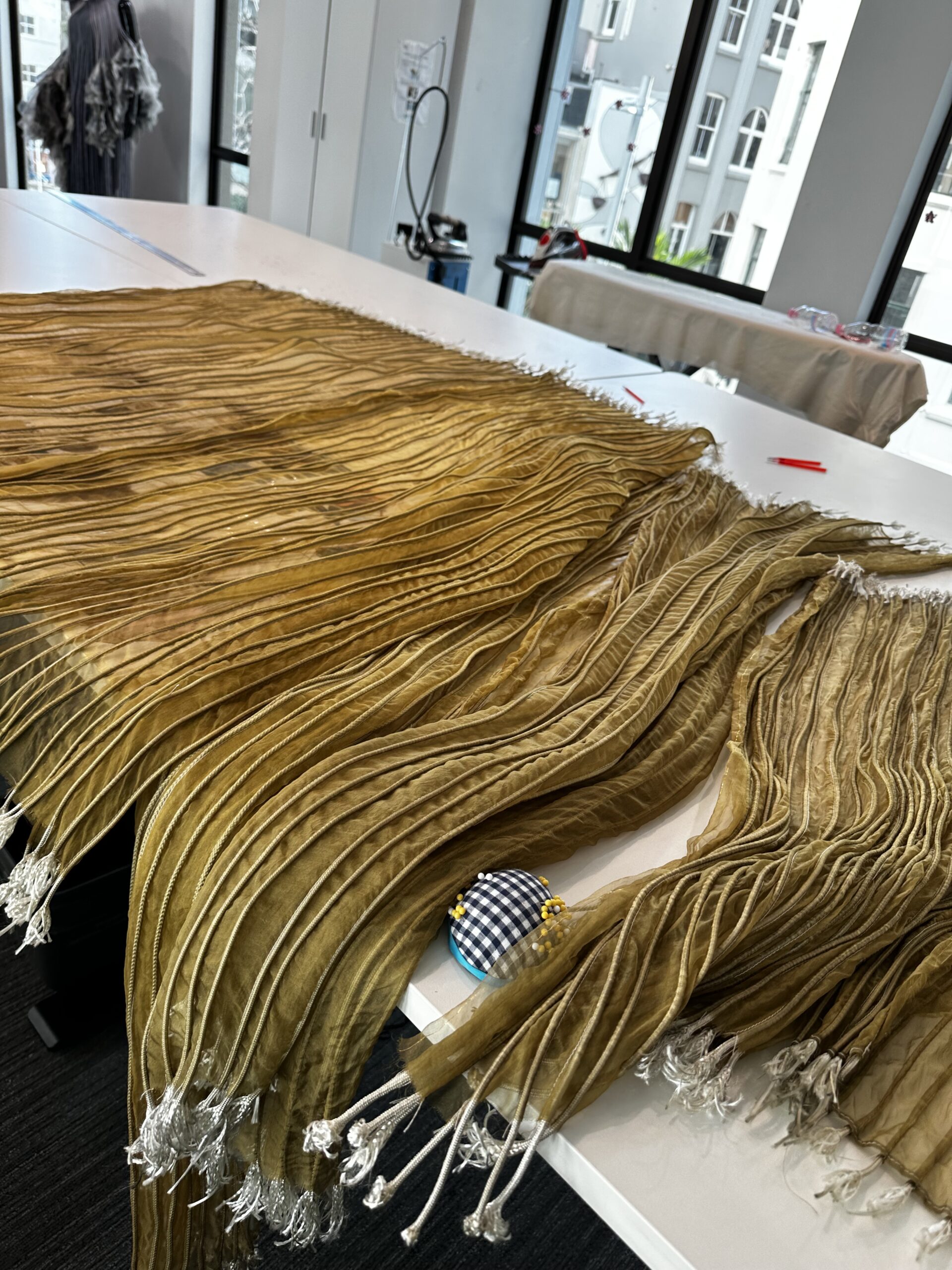
Alongside the cord structures, extensive experimentation was undertaken with pin-tucking, gathering, layering and repeated textile manipulation.
Fine sections of fabric were individually worked to create irregular, feather-like formations. Rather than reproducing feathers literally, the intention was to investigate their qualities like lightness, layering, movement and expansion.
These manipulated surfaces introduced an organic counterpoint to the precise geometry of the cord work.
Dye & Surface Experimentation
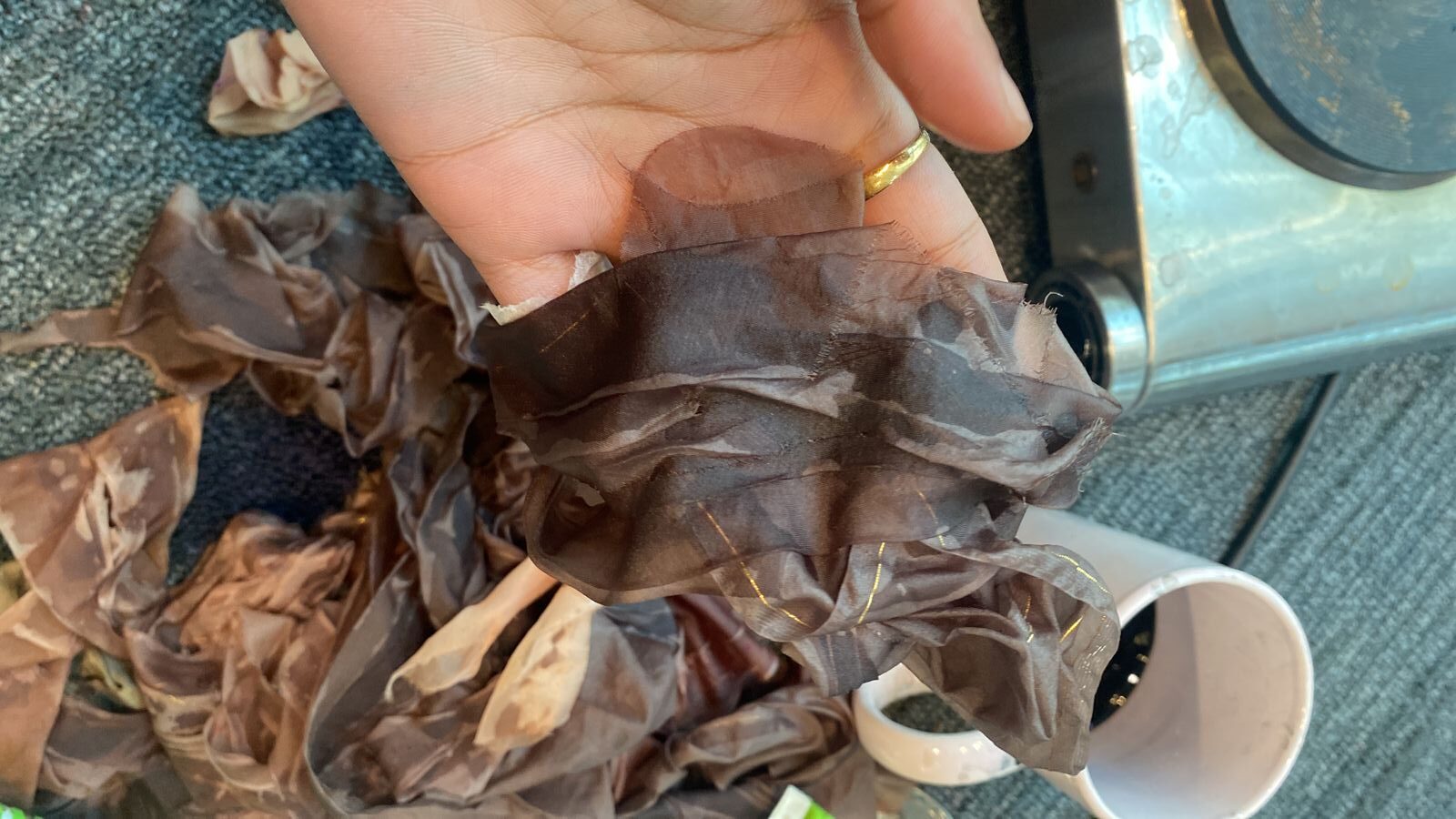
Materials were individually dyed and developed through layered colour studies to create the atmospheric palette of EOS.
Muted rose, dawn gold, mineral grey, lavender and soft earth tones were allowed to merge across the manipulated textiles, producing surfaces that shift subtly as folds separate and move.
Colour therefore became integrated into the construction process rather than applied simply as a finishing element.
Engineering Movement
One of the most technically demanding aspects of EOS was creating large-scale volume without making the work visually or physically static.
Nylon fishing line and concealed structural techniques were experimented with to support extended sections while retaining flexibility. Numerous trials explored tension, spacing, balance and weight distribution.
The resulting structures respond directly to the movement of the wearer: opening, collapsing, rippling and changing their silhouette as the body moves.
Hand Construction
EOS was built through an intensive process of repetition.
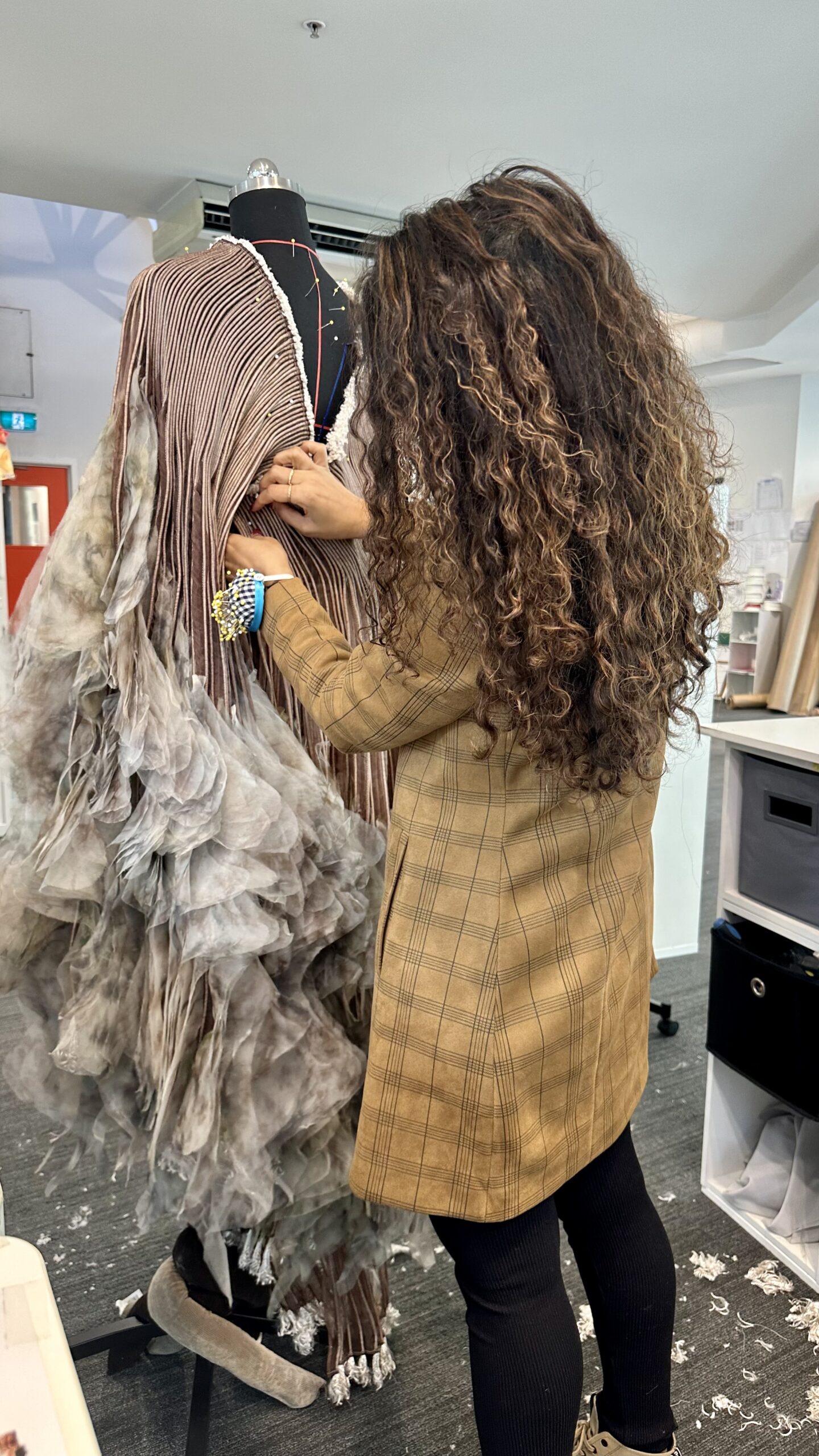
Cord was measured, positioned and secured individually. Textile surfaces were pin-tucked, manipulated, dyed, layered and assembled by hand. Structural sections were repeatedly tested on the body before their proportions were refined.
The enormous quantity of repeated handwork became integral to the visual language of the collection. A single line appears delicate; thousands of lines assembled together become architectural.
This relationship between repetition, material and transformation became one of the central discoveries of EOS.
CRAFTSMANSHIP / STUDIO PROCESS
EOS was realised through an intensive studio process in which repetition, precision and material experimentation gradually transformed individual components into sculptural form.
Each cord was positioned by hand, each textile surface individually manipulated, and each structural element repeatedly tested and refined. What appears fluid and effortless in the finished work is the result of countless small decisions like adjusting tension, proportion, weight, movement and the relationship between material and body.
The making of EOS became a process of accumulation: one line becoming hundreds, one fold becoming a surface, and repeated gestures gradually becoming form.
Through this sustained handwork, craftsmanship became more than a method of construction. It became a record of time, patience and human touch embedded within the artefact.
The finished artefact carries within it the memory of every hand, material experiment and repeated gesture that brought it into being.
