Research
BLACK LIONESS
Year
2024
Medium
Wearable Sculpture
Cultural Context
The development of Black Lioness began with an extensive study of the cultural and symbolic traditions surrounding Goddess Kali within Hindu culture. Rather than approaching the subject through religious iconography alone, the research sought to understand the deeper ideas Kali has represented throughout Indian history—protection, transformation, resilience, justice, compassion, and the continual cycle through which renewal becomes possible.
Particular attention was given to the role of mythology within Indian society. Across generations, these traditional narratives have preserved cultural knowledge, cultural values, and collective memory, continuing to influence art, literature, architecture, music, ritual, and everyday cultural life. The project explores how these enduring traditions remain relevant within contemporary society and continue to shape cultural identity.
Symbolic Research
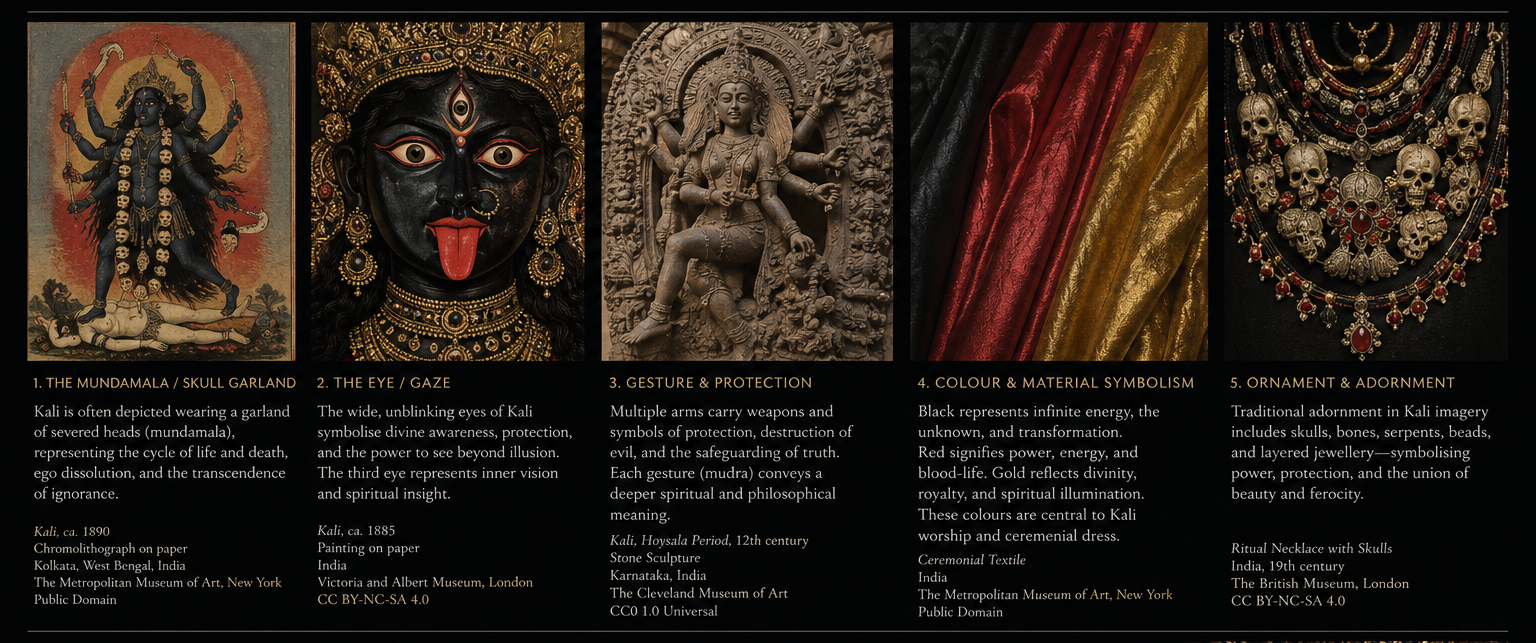
Research focused on the visual and symbolic language associated with Kali, including ceremonial adornment, symbolic ornamentation, expressive gesture, layered forms, and the relationship between strength and compassion. Rather than reproducing traditional imagery, these symbolic qualities became the conceptual foundation for developing a contemporary sculptural interpretation.
Cultural Research
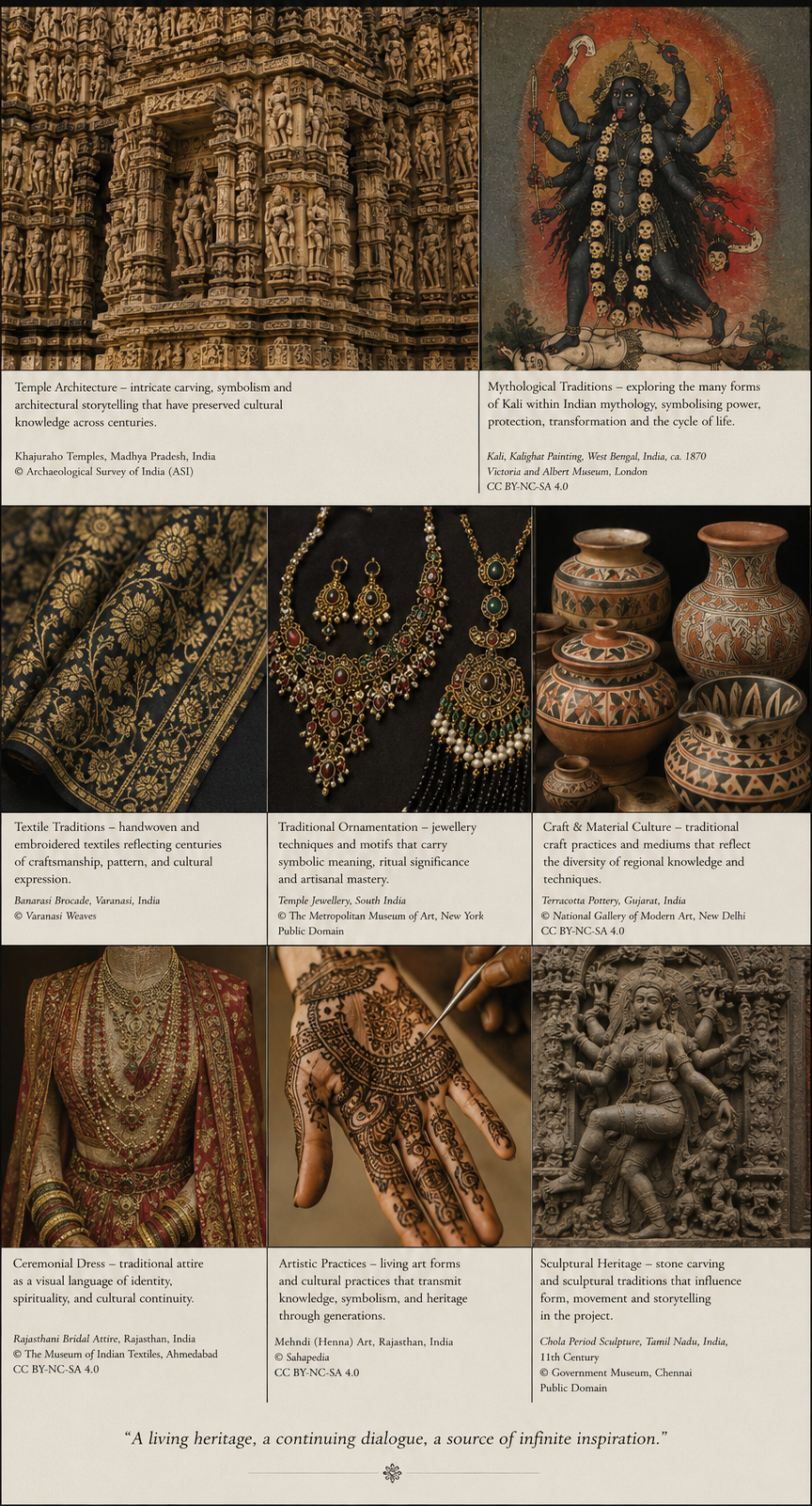
The project examined India’s wider cultural landscape, recognising mythology as part of a living and evolving cultural heritage. It considered how stories, symbols, rituals, and visual traditions continue to influence contemporary Indian life and artistic expression, positioning Black Lioness within a broader cultural context.
Research explored Indian craftsmanship, temple architecture, ceremonial dress, ornamentation, textiles, sculpture, and decorative arts that preserve cultural knowledge across generations. Attention focused on how symbolism, material, craftsmanship, and ritual communicate identity, spirituality, power, and belonging.
The study also considered handmaking and inherited knowledge within contemporary practice. Generational techniques demonstrate how material processes carry cultural memory while allowing traditions to be reinterpreted through new forms and contemporary perspectives.
Temple architecture and sculpture revealed relationships between body, movement, ornament, mythology, and sacred space, showing how layered visual narratives can communicate multiple meanings. Ceremonial dress and ornamentation further demonstrated how garments, jewellery, surface treatments, and adornment express status, identity, spirituality, occasion, and cultural belonging.
These investigations informed the visual language, material direction, sculptural construction, and conceptual development of Black Lioness. Rather than reproducing traditional forms directly, the research established a foundation for contemporary interpretation while maintaining connections to their cultural origins.
The project ultimately explored how heritage and contemporary practice can exist in dialogue, treating traditional knowledge as a continuing source of inspiration capable of generating new artistic possibilities while remaining connected to its cultural origins and enduring significance.
Conceptual Research
Key themes explored throughout the research process included Protection, Transformation, Resilience, Courage, Compassion, Justice, Cultural Identity, Cultural Continuity, Collective Memory, Heritage, Ritual, and Feminine Strength.
Together, these ideas informed both the narrative framework and the sculptural development of Black Lioness, allowing the work to move beyond literal representation and instead explore how traditional narratives continue to inspire contemporary artistic practice.
Design Development
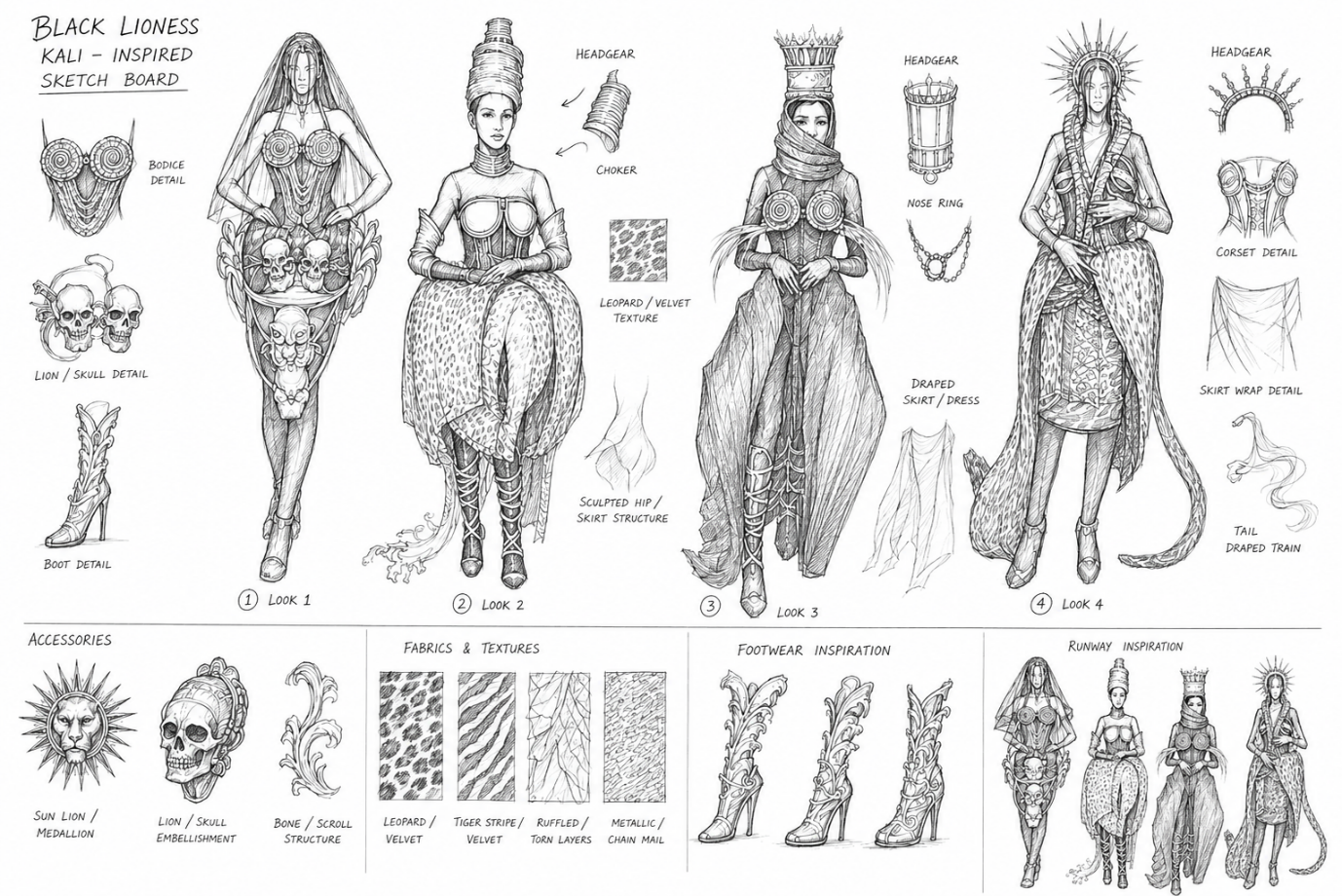
The design development of Black Lioness translated cultural research into sculptural form through an extended process of sketching, experimentation, and structural exploration. Rather than illustrating Goddess Kali directly, the intention was to interpret the symbolic qualities of protection, transformation, courage, and resilience through contemporary wearable sculpture.
Silhouette Development
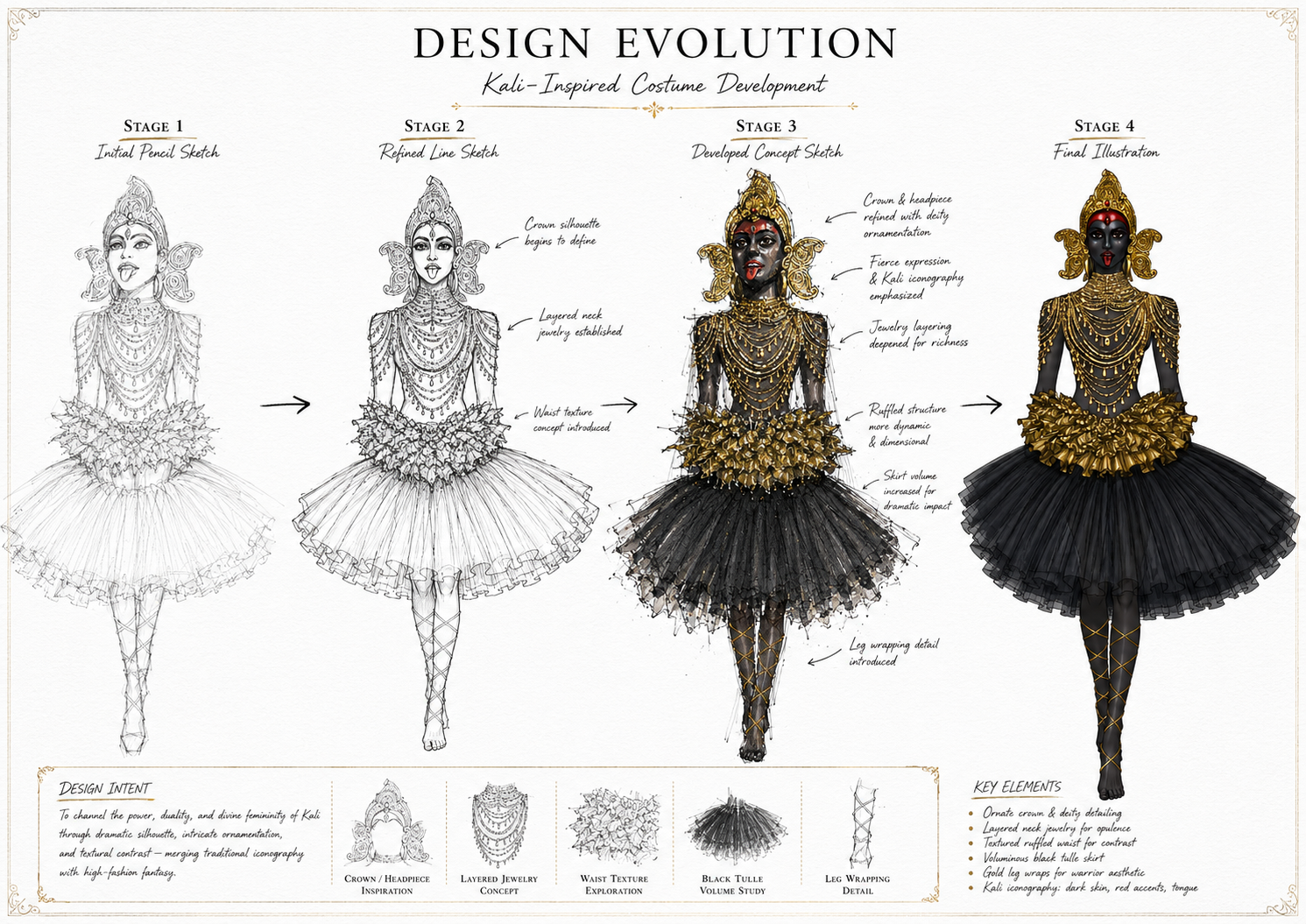
Early concept sketches explored bold, commanding silhouettes that conveyed strength and presence while maintaining a sense of ceremonial elegance. Layered proportions, sculptural volume, and strong vertical forms were developed to communicate authority, movement, and transformation without relying on literal representation.
SURFACE DEVELOPMENT
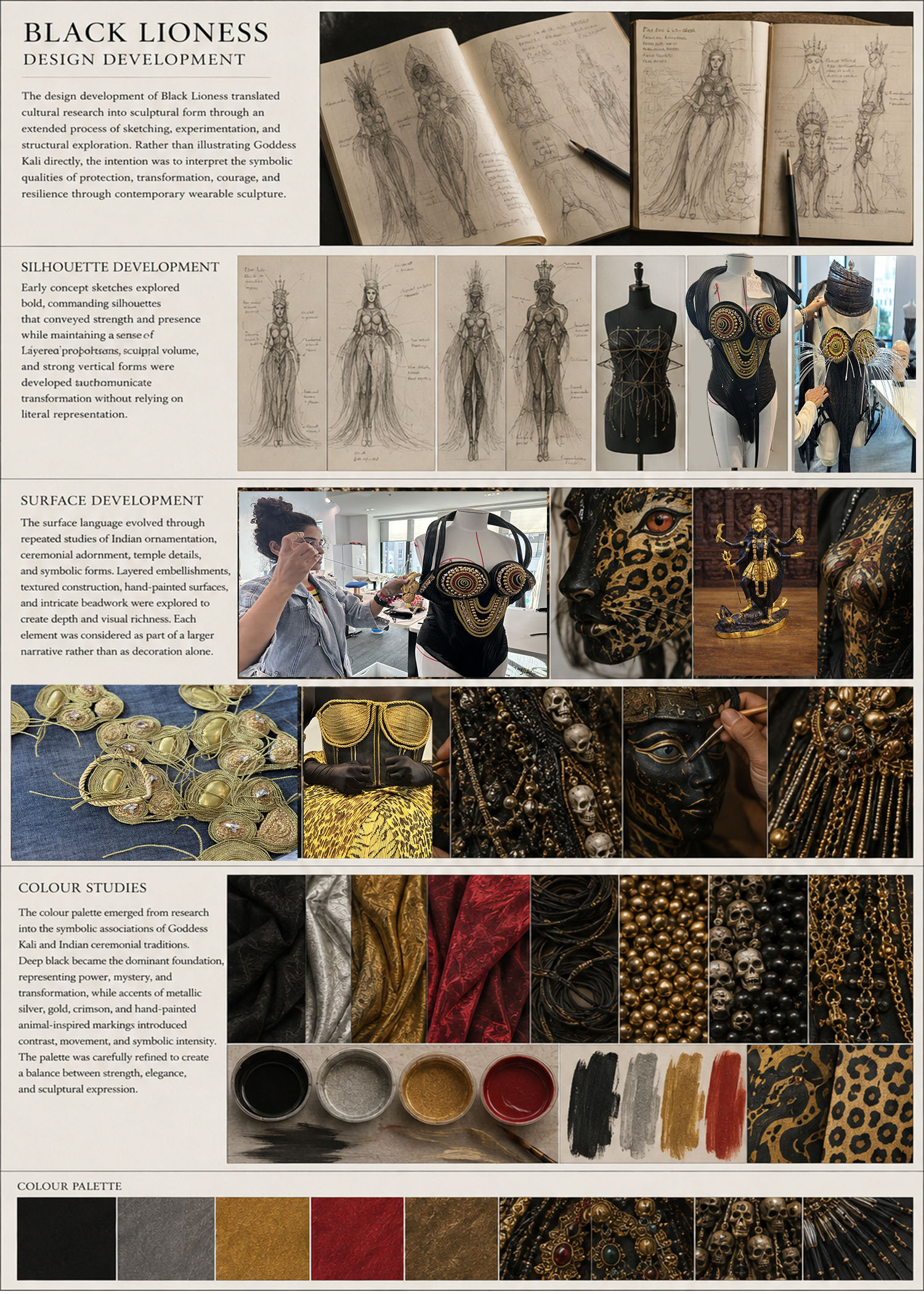
The surface language developed through studies of Indian ornamentation, ceremonial adornment, temple details, textiles, jewellery, and symbolic forms. These references explored how texture and embellishment could communicate cultural meaning while strengthening the sculpture’s identity.
Layered embellishments, textured construction, hand-painted surfaces, beadwork, and decorative elements were experimented with to create depth, movement, contrast, and visual richness, allowing the surface to respond to the underlying structure.
The relationship between ornament and form remained central, with each element enhancing the silhouette and visual rhythm. Hand-applied details introduced craftsmanship, while traditional references were reinterpreted through contemporary materials and techniques.
Together, these elements formed a cultural and conceptual narrative addressing heritage, identity, strength, transformation, and memory through contemporary sculptural language.
COLOUR STUDIES
The colour palette emerged from research into the symbolic associations of Goddess Kali and Indian ceremonial traditions. Deep black became the dominant foundation, representing power, mystery, and transformation, while accents of metallic silver, gold, crimson, and hand-painted animal-inspired markings introduced contrast, movement, and symbolic intensity. The palette was carefully refined to create a balance between strength, elegance, and sculptural expression.
Design Refinement
MATERIAL EXPLORATION AND CONSTRUCTION
The material development of Black Lioness focused on translating cultural symbolism into sculptural form through an extensive process of experimentation, hand construction, and technical refinement. Every material was selected not only for its visual qualities but also for its ability to communicate strength, ritual, movement, and transformation.
MATERIAL EXPLORATION
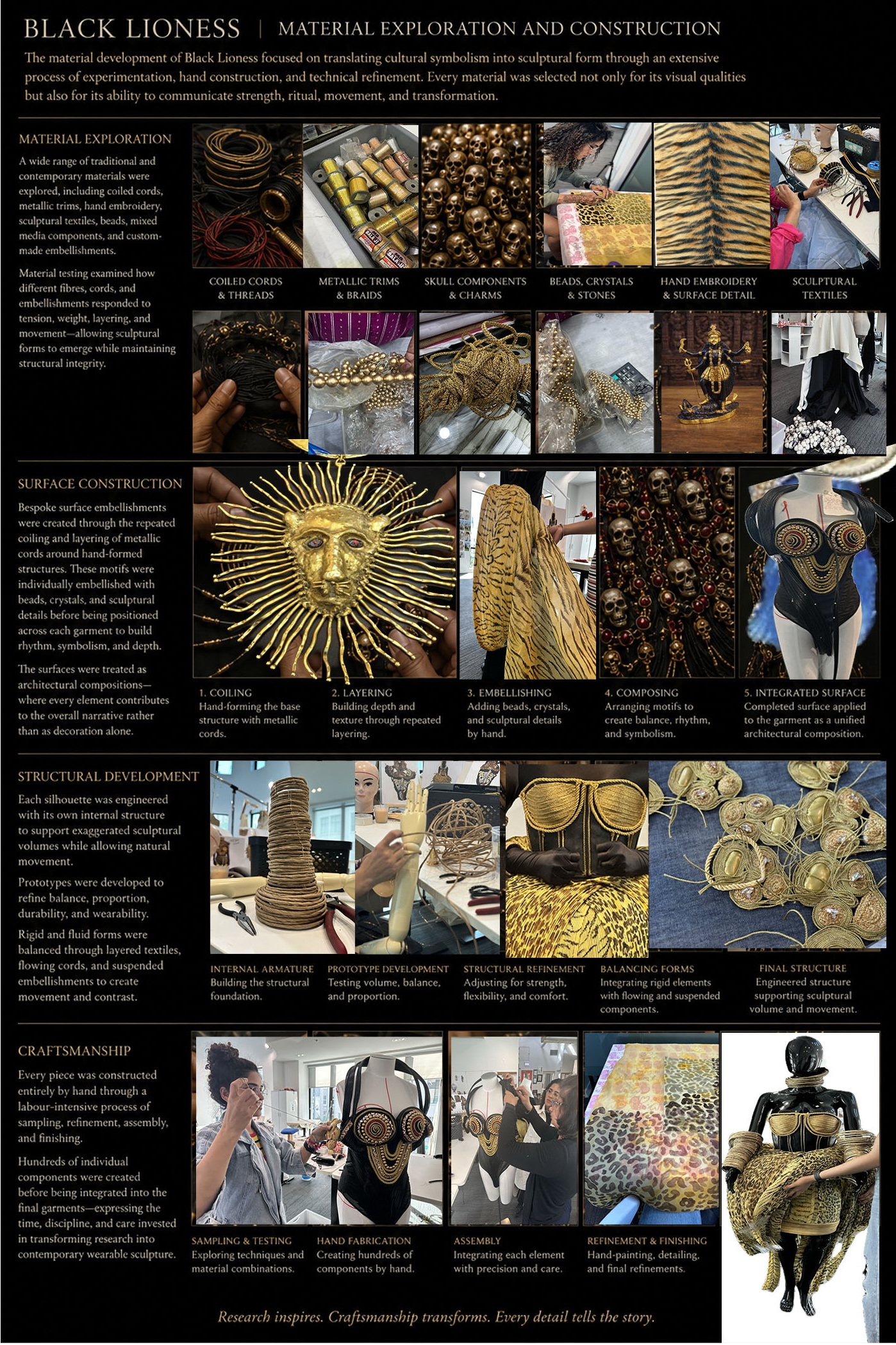
The project combined a wide range of traditional and contemporary materials, including coiled cords, metallic trims, hand embroidery, sculptural textiles, beads, mixed media components, and custom-made embellishments. Rather than relying on commercially available decorative elements, many surface components were individually developed and assembled by hand to establish a unique visual language specific to the collection.
Material testing explored how different fibres, cords, and embellishments responded to tension, weight, layering, and movement, allowing sculptural forms to emerge while maintaining structural integrity.
SURFACE CONSTRUCTION
A significant part of the construction process involved developing bespoke surface embellishments. Individual motifs were created through the repeated coiling and layering of metallic cords around hand-formed structures before being individually embellished with beads, crystals, and sculptural details. These handcrafted components were then carefully positioned across each garment to build rhythm, symbolism, and visual depth.
The surfaces were treated as architectural compositions, where every element contributed to the overall narrative rather than functioning as ornament alone.
STRUCTURAL DEVELOPMENT
Each silhouette required its own engineered internal structure to support exaggerated sculptural volumes while allowing the body to move naturally. Multiple prototypes were developed to refine balance, proportion, durability, and wearability.
The collection also explored the relationship between rigid and fluid forms. Structured components were balanced with layered textile constructions, flowing cords, and suspended embellishments to create movement and contrast throughout the body of work.
CRAFTSMANSHIP
Every piece within Black Lioness was constructed entirely by hand through a labour-intensive process of sampling, refinement, assembly, and finishing. Hundreds of individually fabricated components were produced before being integrated into the final garments, reflecting the project’s commitment to craftsmanship as a form of storytelling.
Rather than concealing the handmade process, the visible construction became an essential part of the work’s identity, expressing the time, discipline, and care invested in transforming research into contemporary wearable sculpture.