
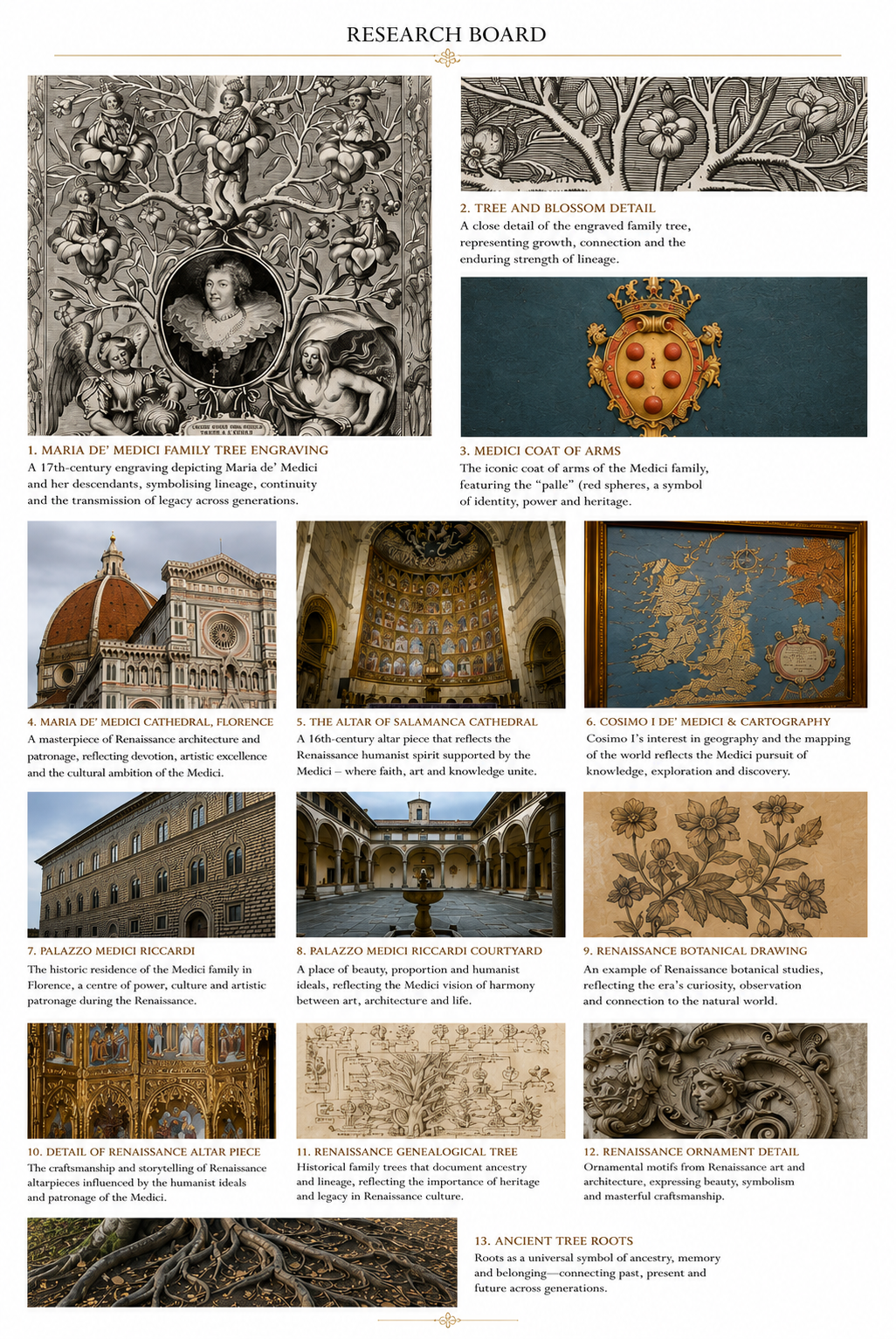
During my research into Florence and the Medici family, I became fascinated by the extraordinary relationship between art, knowledge, power, and cultural legacy.
Throughout history, many rulers have accumulated wealth and influence. What distinguished the Medici was their belief that culture itself could shape society. Through their patronage of artists, architects, scholars, scientists, and thinkers, they contributed to an environment that helped define the Renaissance and transformed Florence into one of the most influential cultural centres in history.
What resonated with me was the understanding that art was not viewed as decoration, but as an essential part of civilisation. Creativity was supported as a vehicle for knowledge, identity, innovation, and collective memory. The cultural investments made by the Medici continue to influence the world centuries later through architecture, literature, scientific discovery, and artistic achievement.
As I explored this history, I began to see parallels between cultural patronage and contemporary conversations surrounding identity, heritage, and cultural understanding. The Medici story demonstrates how ideas can outlive generations and how cultural contributions can become a lasting form of diplomacy between societies and across time.
This discovery became the foundation for my ongoing Medici Project, a body of work exploring the relationship between culture, knowledge, legacy, and human achievement.
The project consists of four interconnected chapters.
One chapter draws inspiration from a historical drawing documenting the lineage of Maria de’ Medici and her descendants, exploring themes of ancestry, continuity, and the transmission of cultural memory across generations.
A second chapter examines the architectural beauty and spiritual presence of Florence Cathedral, reflecting on the ability of architecture to embody collective ambition, faith, and cultural identity.
A third chapter is inspired by Cosimo de’ Medici’s interest in geography, cartography, and the mapping of the known world. Through this work, I explore the relationship between knowledge, curiosity, exploration, and humanity’s enduring desire to understand its place within a wider global landscape.
The fourth chapter draws inspiration from the sculptural storytelling of the Salamanca Cathedral altar, examining how narrative, symbolism, and craftsmanship can preserve cultural knowledge and communicate meaning across centuries. Salamanca Cathedral, with its layered architectural history spanning Gothic and Baroque influences, reflects a similar commitment to cultural expression seen in Florence. Its intricate carvings and symbolic narratives demonstrate how sacred spaces can function as repositories of collective memory, much like the Medici’s patronage transformed Florence into a living archive of artistic and intellectual achievement. This connection highlights how different regions, though distinct in style and context, share a common pursuit of preserving identity and meaning through art.
Together, these works investigate a central question that continues to guide my artistic practice:
How can culture preserve knowledge, strengthen identity, and create meaningful connections between people, communities, and nations?
For me, Florence represents more than a city. It represents a powerful reminder that cultural investment can shape the future, that creativity can influence society, and that art has the capacity to become a lasting bridge between generations, histories, and civilisations.
